
Download the app by scanning the QR code or clicking the links below:


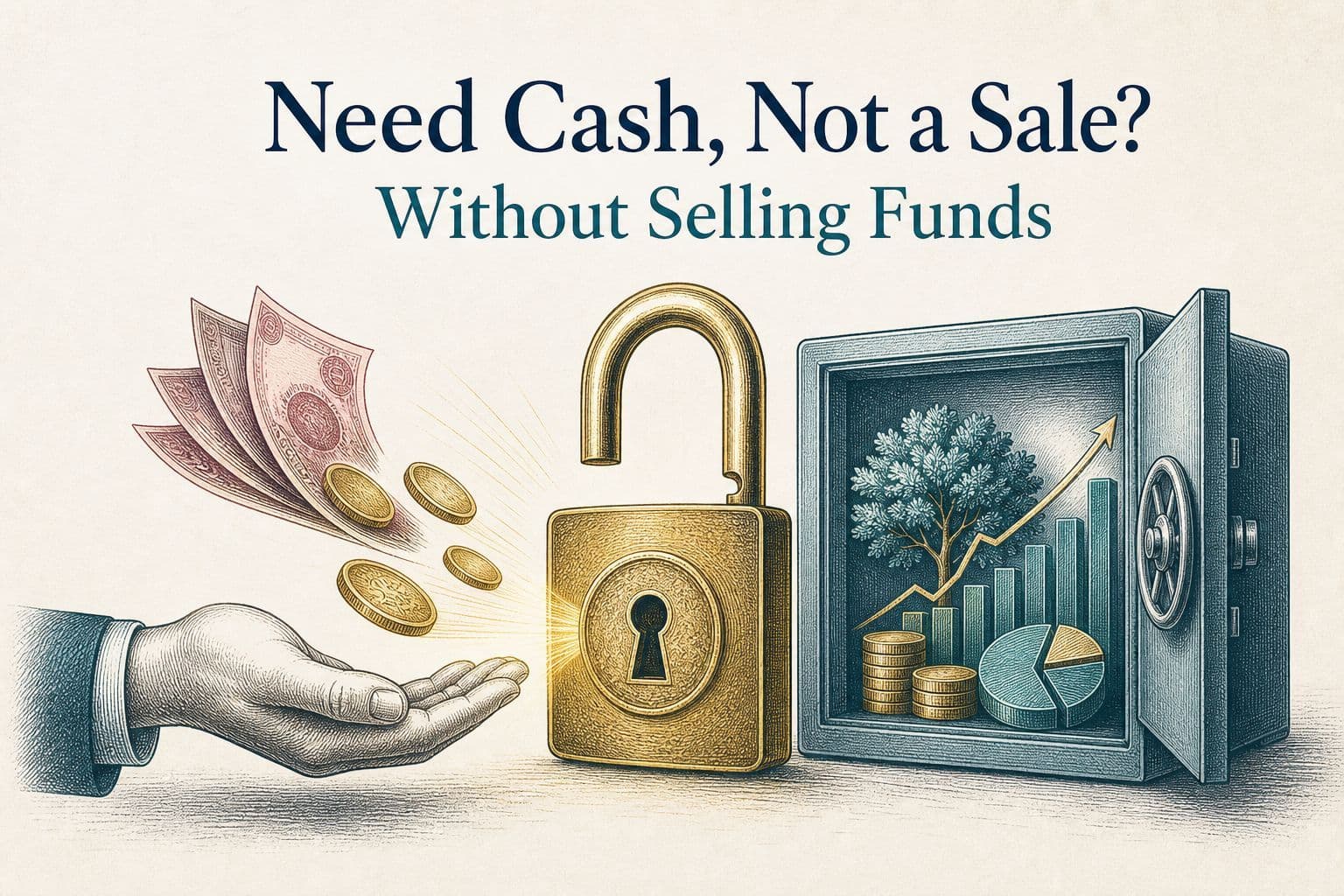
If you need cash quickly, selling mutual funds can feel like the obvious move.
The money is already yours. The portfolio is already there. Redemption looks simple.
But simple is not always smart.
If the need is temporary, selling long-term investments can quietly become the expensive option. You may solve today’s problem and still damage tomorrow’s compounding. That is why investors should think about short-term liquidity differently from generic borrowing.
Key Takeaways
- Selling mutual funds is only one way to raise cash, and it is not always the smartest one.
- For a temporary liquidity need, a loan against mutual funds can help you access funds while staying invested.
- The right option depends on speed, repayment capacity, and whether the cash need is truly short term.
If the cash need is temporary, the first question should not be “How fast can I redeem?”
The better question is “How can I solve this without permanently reducing the investments I built for the long term?”
That shift matters because investors often treat their portfolio as the easiest emergency funding source without fully noticing the long-term cost of stepping out too early.
A temporary cash problem does not automatically require a permanent investing decision.
If you need a broad product explainer first, Yenmo’s complete guide to loans against mutual funds is a strong starting point.
Before you pick any option, compare these three things:
That third point is where many good investors make avoidable mistakes.
A source of funds can look convenient and still be expensive in a deeper way. Selling mutual funds may avoid a visible loan quote, but it can still cost you future growth, tax impact, and the difficulty of rebuilding the position later.
For an investor who already holds mutual funds, this is often the most important option to evaluate first.
Why? Because it matches the actual job.
The job is not “find cash at any cost.” The job is “get through a temporary liquidity gap without casually undoing a long-term investment plan.”
A loan against mutual funds is built around that idea. Instead of redeeming the units, you pledge eligible holdings and borrow against them. That means the investments can remain invested while supporting the loan.
That distinction is the whole point.
You are not trying to convert a long-term asset into a permanent exit. You are trying to use it as support while the temporary problem passes.
Yenmo’s loan against mutual funds page explains this structure clearly, and the loan vs redemption calculator is the best next step if you want to compare the decision more concretely.
LAMF tends to make the most sense when these conditions are true.
If you believe the mutual fund still belongs in your long-term plan, selling should not be the default answer.
This structure is strongest when the problem will pass and repayment is realistic.
That is where staying invested becomes a real advantage instead of just a nice-sounding feature.
The strength of a loan against mutual funds is that it treats liquidity as a temporary gap, not as a reason to dismantle a long-term portfolio.
A personal loan may still be the right answer in some situations.
If you do not have eligible holdings, if you prefer an unsecured route, or if the product structure fits your situation better, it can be worth considering.
But investors should compare it honestly.
If you already have mutual funds and do not want to sell them, an unsecured loan is not automatically the smarter option just because it is more familiar. It may come with a very different cost and repayment experience.
That is especially true if your need is short term and you want to avoid heavy monthly pressure.
If you want the side-by-side comparison, Yenmo’s loan against mutual fund vs personal loan guide is the right companion piece.
This sounds obvious, but it still matters.
If you already have a clean emergency buffer or near-cash reserve set aside for exactly this kind of situation, use that before disturbing long-term investments.
The key phrase here is “set aside for exactly this situation.”
Investors sometimes call a long-term mutual fund portfolio an emergency buffer simply because it is accessible. That does not make it the same as actual emergency cash.
A real cash buffer protects the portfolio. It does not compete with it.
Selling is not always wrong.
In some cases, it is the better decision.
If the need is not temporary, if the holdings are not eligible for borrowing, or if repayment would be uncertain enough to make a loan stressful, redeeming may still be the cleaner move.
That does not weaken the case for borrowing. It strengthens the decision logic.
A good investor should not borrow simply to avoid admitting that the cash need is larger or longer than expected.
Borrowing works best when it protects a strong long-term plan. It works badly when it is used to postpone an unavoidable portfolio decision.
For many invested professionals, the practical sequence looks like this:
That is a much more useful framework than starting from redemption and treating every other option as a backup.
Short-term cash decisions are easy to underestimate.
The amount may not feel life-changing. The redemption may not look dramatic. The sale may even feel responsible because you are “using your own money.”
But from an investor’s point of view, the real cost is often hidden in what comes next.
Will you rebuild the position quickly?
Will you miss future compounding on the units you sold?
Will the cash need pass in a few months and leave you wishing you had found a way to stay invested instead?
Those are the questions that make this topic important.
It depends on the situation, but if the need is temporary and you want to protect long-term investments, you should evaluate options that preserve the portfolio before assuming you need to sell it.
Not automatically. If the need is temporary, selling may solve the immediate problem but still interrupt compounding and reduce your long-term exposure.
It often can be for investors who already hold mutual funds and want to stay invested. The answer depends on cost, structure, and whether the need is genuinely short term.
Redeeming may be cleaner when the need is not temporary, the holdings are not eligible, or repayment would be too uncertain to manage comfortably.
Because the visible cost may be low while the hidden cost includes lost future growth, tax impact, and the difficulty of rebuilding the position later.
The best way to raise short-term cash as an investor is not always the fastest-looking one.
If the need is temporary, the smarter goal is usually to solve the liquidity gap without casually sacrificing long-term compounding.
That is why selling mutual funds should not be your default move.
For many investors, the better path is to stay invested, borrow responsibly if the structure fits, and treat redemption as a deliberate choice rather than a reflex.