Overdraft Against Mutual Funds: How It Works, What It Costs and How to Get One
By Ashutosh Purohit
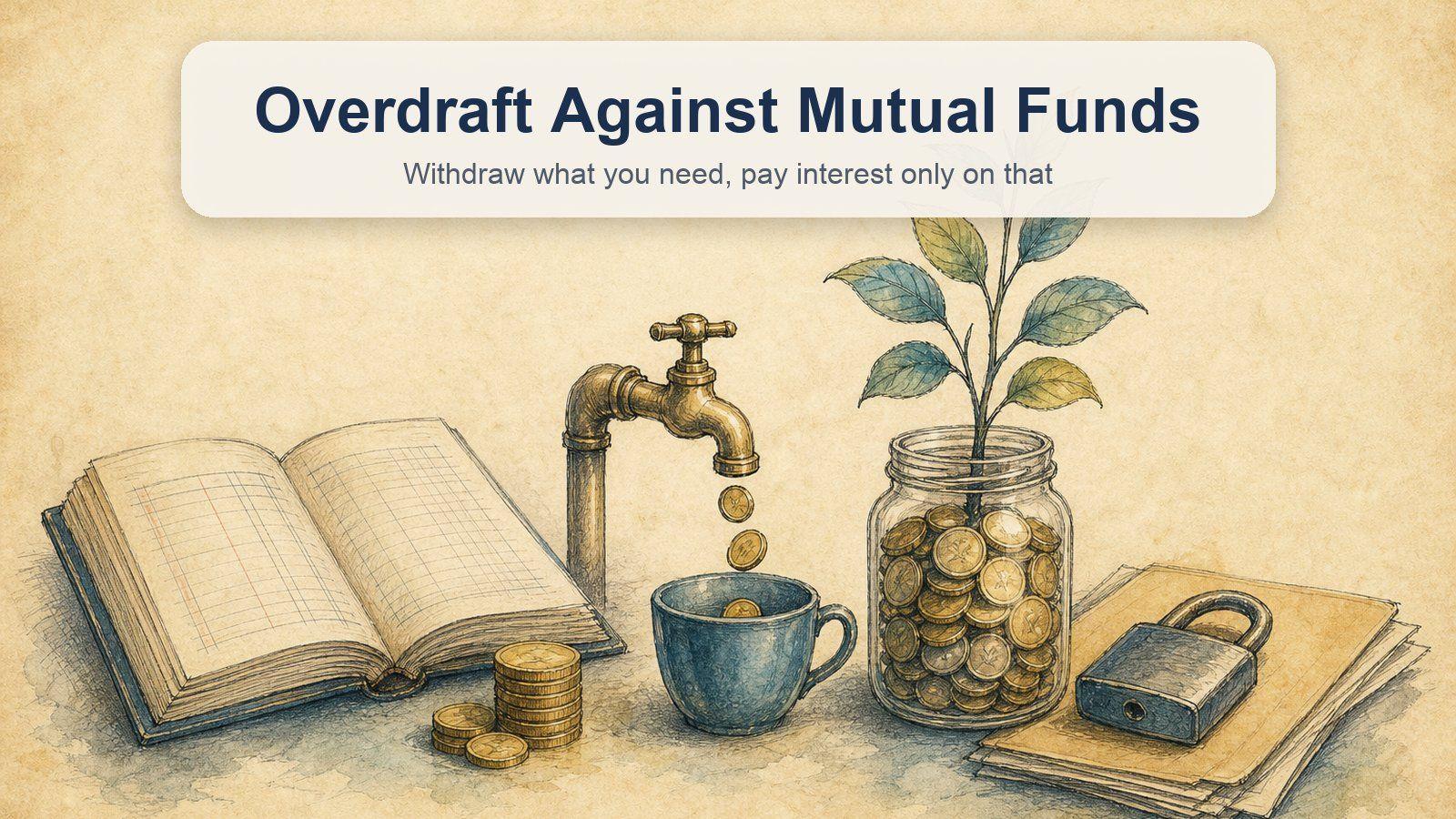
Your bank or an investment app has offered you an "overdraft against mutual funds", and you want to know what you'd be signing up for. It is a credit line backed by your mutual funds. You pledge your units, the lender sets a limit, and you withdraw only what you need, paying interest only on that amount. At Yenmo, this credit line runs for 3 years at 9.89% to 10.49% a year, with no annual fee and no charge for closing early.
The short version
- You pledge your mutual fund units. They stay in your name and stay invested.
- You get a limit and withdraw from it when you need money, from ₹500 at a time.
- Interest runs only on the amount you've withdrawn, and there's no EMI.
- At Yenmo, you pay a one-time processing fee from ₹1,649 + GST, with ₹0 annual fee and ₹0 foreclosure charge.
What is an overdraft against mutual funds?
It's a credit line secured by the mutual funds you already own. Lenders and apps call it different things, such as an overdraft, an OD, a flexi loan or a credit line, but they work the same way. Yenmo calls it a credit line.
You don't sell anything. You pledge your units, which means the lender places a lien on them. A lien is a hold that stops you from selling or redeeming those units while the loan is open.
For funds held with CAMS or KFintech, the lien is marked with the registrar. The units never move to Yenmo or to the lender, so they keep earning whatever the fund earns, and your SIP can keep running.
The word "overdraft" comes from bank accounts, where it lets you spend more than your balance. Our guide to bank overdrafts covers that kind.
How is it different from a personal loan or a term loan?
A personal loan pays you the full amount on day one, and you start paying interest on all of it straight away. An overdraft gives you a limit instead. You draw from it in parts, and interest runs only on what you've drawn.
| Overdraft against mutual funds | Personal loan or term loan | |
|---|---|---|
| How you get the money | Withdraw any amount up to your limit, whenever you need it | The full amount is paid out at the start |
| Interest | Only on the amount you've withdrawn | On the full loan amount from day one |
| Repayment | Interest each month, and repay the amount itself when you like | Fixed EMIs of principal and interest |
| Using it again | Money you repay can be withdrawn again | Once it's repaid, you apply again |
| What backs it | Your pledged mutual funds | Usually your income and credit history |
So an overdraft suits needs that come in uneven amounts or at uncertain times, like a house repair paid in stages. If you need one fixed sum for several years and want a set repayment plan, a term loan with EMIs may be simpler. We compare the two in more detail in loan against mutual funds vs personal loan.
How much can you withdraw?
Two numbers decide this, and people often mix them up. The sanctioned limit is the most the lender has agreed to lend you. What you can actually withdraw today, which banks call the drawing power, is the value of your pledged funds multiplied by the loan-to-value ratio, or LTV.
Through Yenmo, our lending partner Bajaj Finance applies these LTVs:
| Fund type | LTV through Yenmo (Bajaj Finance) |
|---|---|
| Equity funds | 50% |
| Liquid funds | Up to 90% |
| Other debt funds | Typically 70%–80% |
So ₹4 lakh of equity funds lets you withdraw up to ₹2 lakh, even if your sanctioned limit is higher. Some people set the sanction above what they can draw today because they plan to pledge more funds later. Pledging more within that sanction needs no new agreement and no new processing fee, though pledge charges still apply.
The 50% on equity funds is an RBI limit for NBFC lenders, set in the NBFC Credit Facilities Directions, 2025. Banks follow different rules.
Since 1 July 2026, RBI allows banks to lend up to 75% against equity funds and 85% against debt funds (RBI/2025-26/254). Bank loans against shares and equity funds are capped at ₹1 crore per person, and each bank sets its own LTV within these limits. So if most of your money is in equity funds and you need a large share of its value, a bank may give you a bigger limit.
The smallest loan at Yenmo is ₹25,000, and the largest you can take online is ₹5 crore. You can try your own numbers on the loan against mutual fund calculator.
What does it cost at Yenmo?
Your interest rate is set by the size of your sanctioned limit:
| Sanctioned amount | Interest rate (a year) |
|---|---|
| ₹2 crore and above | 9.89% |
| ₹1 crore – ₹2 crore | 9.99% |
| ₹50 lakh – ₹1 crore | 10.09% |
| ₹25 lakh – ₹50 lakh | 10.19% |
| ₹10 lakh – ₹25 lakh | 10.29% |
| ₹2 lakh – ₹10 lakh | 10.39% |
| ₹25,000 – ₹2 lakh | 10.49% |
No loan at Yenmo is priced over 10.49% a year.
You pay a processing fee once, from ₹1,649 + GST, and it's the same whatever your sanctioned limit. It covers stamp duty and your first pledge and unpledge.
The credit line runs for 3 years, so there's no yearly renewal and no annual fee in that time. Repaying part or all of the amount early costs ₹0. Smaller lender charges, such as pledge fees, are listed in full on our charges page.
A worked example
Say Arjun is a freelance architect in Pune. His clients often pay 60 to 90 days late, and he has ₹8 lakh in equity index funds held with CAMS. He doesn't want to sell them, so he opens a credit line.
At 50% LTV, his ₹8 lakh of funds gives him up to ₹4 lakh to withdraw. He takes a ₹4 lakh sanction, which falls in the ₹2 lakh to ₹10 lakh slab, so his rate is 10.39% a year. At that rate, every ₹1 lakh withdrawn costs about ₹866 a month.
Here's how six months go:
- In months 1 and 2, he withdraws ₹1 lakh to pay his team. Interest is about ₹866 a month, so ₹1,732.
- In month 3, a supplier bill comes in and he withdraws another ₹1 lakh. With ₹2 lakh out for months 3 and 4, interest is about ₹1,732 a month, so ₹3,463.
- In month 5, one client pays and he repays ₹1 lakh. Interest for months 5 and 6 drops back to about ₹866 a month, so ₹1,732.
- At the end of month 6, the second client pays and he repays the last ₹1 lakh with no foreclosure charge.
His total interest is about ₹6,927, plus the one-time ₹1,649 + GST processing fee. Had he borrowed the full ₹2 lakh as a lump sum on day one, six months of interest at the same 10.39% would have been ₹10,390.
These are rounded monthly figures. Your loan statement shows the exact interest.
What happens if the market falls?
Your limit is tied to the current value of your pledged funds, so it falls when the market falls. Bajaj Finance compares that limit with the amount you've actually withdrawn, and it calls this the cover.
If your limit drops to 90% of what you've withdrawn, you get 7 business days to repay part of it or pledge more funds. If it drops below 85%, Bajaj sells pledged funds straight away and informs you.
The way to stay safe is to withdraw well below your limit. Arjun never had more than ₹2 lakh out against his ₹4 lakh limit. His funds would have had to fall by 55%, from ₹8 lakh to ₹3.6 lakh, before he was asked to top up.
Had he withdrawn the full ₹4 lakh, a 10% fall would have been enough. We explain this in more detail in what happens if your mutual funds fall after you take a loan.
An overdraft also makes most sense for short or known needs. If you'd keep the money out for years, add up the interest and compare it with what your funds are likely to earn.
How do you close an overdraft against mutual funds?
You repay what you've withdrawn, plus any interest due, and then unpledge your funds. There's no charge for closing early.
Unpledging is self-serve. In the Yenmo app or on the website, you pick the fund and the units and press a button. We send the request to the lender, because only the lender can lift the lien. You don't need to contact support.
If you still need the line at the end of 3 years, you can renew it for another 3 years by paying the processing fee again. Otherwise you close it.
How do you get one at Yenmo?
Start with the eligibility check on the loan against mutual funds page. It begins with the mobile number linked to your investments. You'll need your PAN, Aadhaar for KYC and a bank account, and there's no minimum credit score. Bajaj Finance lends to people aged 21 to 70.
For funds held with CAMS or KFintech, the application takes about 5 to 7 minutes online. For funds in a demat account, you start by writing to support@yenmo.in, and the rest is digital with no forms. One account can hold funds from CAMS and KFintech folios and from more than one demat account, under a single limit.
If you have a need coming up and don't want to sell your funds, check your limit first. The check takes a few minutes, and interest starts only when you withdraw.
Frequently asked questions
What is an overdraft against mutual funds?
It's a credit line backed by mutual fund units you pledge to a lender. You withdraw what you need up to your limit and pay interest only on that amount, while the units stay invested in your name.
How is interest charged on an overdraft against mutual funds?
Interest is charged only on the amount you've withdrawn, not on your full limit. At Yenmo, you pay the interest each month and repay the amount itself whenever you like, with no EMI. Rates run from 9.89% to 10.49% a year, set by your sanctioned limit.
How much overdraft can I get against my mutual funds?
It depends on the fund type. Through Yenmo, Bajaj Finance lends 50% of the value of equity funds, up to 90% of liquid funds and typically 70% to 80% of other debt funds. Loans start at ₹25,000.
How is an overdraft against mutual funds different from a personal loan?
A personal loan pays out the full amount at the start, and you pay interest on all of it through fixed EMIs. An overdraft gives you a limit to draw from in parts, so you pay interest only on what you use, and repaid money can be withdrawn again.
Do my mutual funds keep earning while they are pledged?
Yes. The units stay in your name and keep earning whatever the fund earns. The lien only stops you from selling or redeeming the pledged units until you repay and unpledge them.
How do I close an overdraft against mutual funds?
Repay what you've withdrawn and any interest due, then unpledge your funds. At Yenmo there's no foreclosure charge, and you unpledge yourself in the app or on the website by picking the fund and units.
Yenmo Technologies Pvt Ltd is a loan service provider. Loans are sanctioned and disbursed by RBI-regulated lending partners.