Loan Against Shares in India: Interest Rates, LTV and How to Borrow (2026)
Loan Against Shares in India: Interest Rates, LTV and How to Borrow (2026)
By Ashutosh Purohit
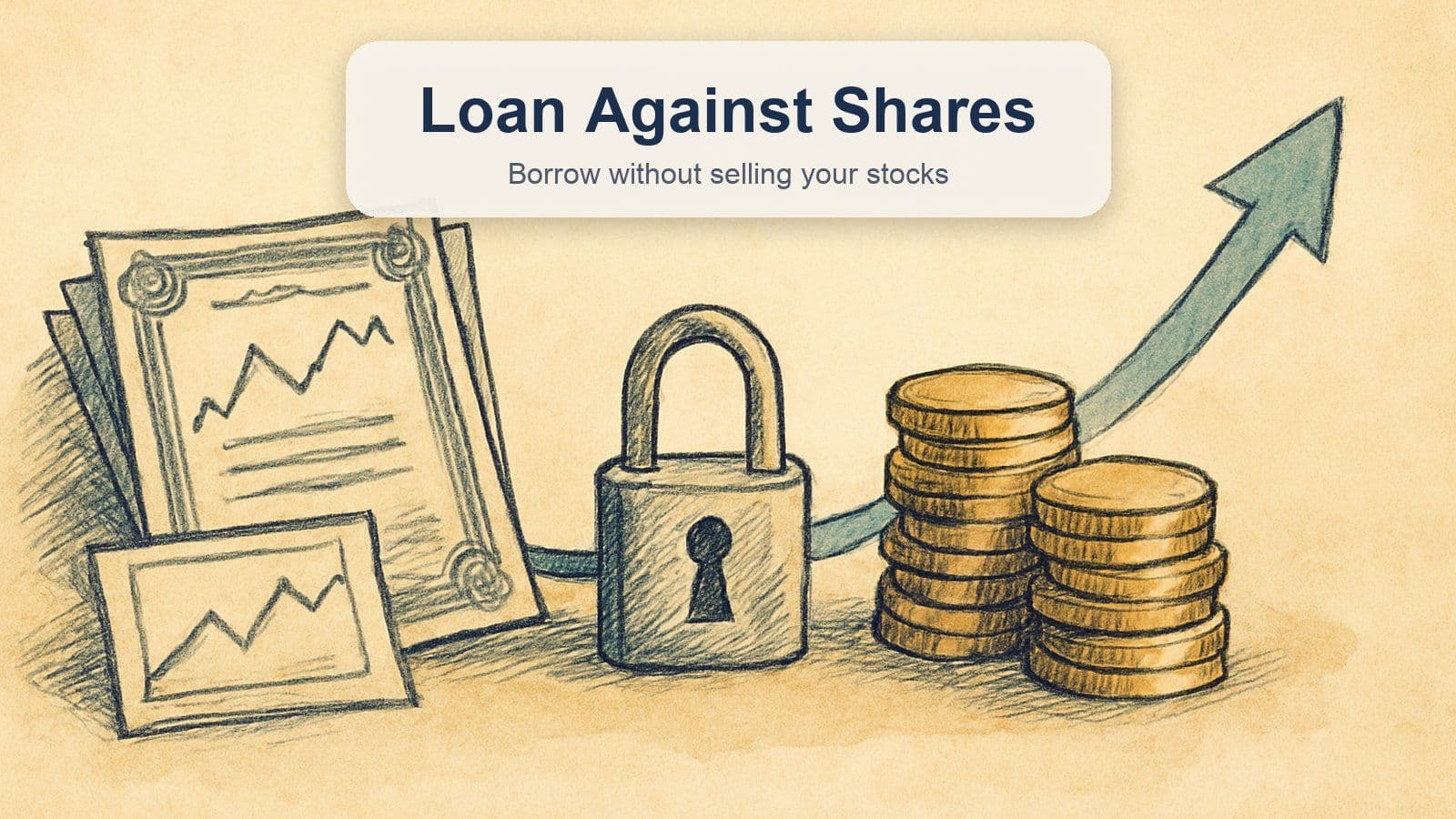
You have shares in a demat account, and you need money for a few months. You don't want to sell your shares to get it. A loan against shares lets you borrow money and keep your shares. You pledge the shares to a lender, which puts a hold on them until you repay.
RBI sets how much you can borrow. Larger NBFCs, which are lenders that are not banks, can lend up to 50% of the value of listed shares. Banks can lend up to 60%, within a ₹1 crore limit.
On Yenmo, one loan account can take your shares and mutual funds from Zerodha, Groww, Upstox and CAMS/KFintech together. Loans start at ₹25,000, and you pay interest only on the amount you withdraw.
The short version
- You keep your shares. They are pledged, not sold, so they stay in your demat account and stay invested.
- NBFCs with assets of ₹100 crore or more can lend up to 50% of the value of listed shares. Banks can lend up to 60%, within a ₹1 crore cap per person across all banks.
- Yenmo puts stocks, demat mutual funds and mutual funds held with CAMS/KFintech into one account, even if they sit with different brokers.
- You pay interest only on what you withdraw. There is no EMI, no foreclosure or part-payment charge, and no annual fee for the 3-year credit line.
What is a loan against shares?
A loan against shares is a secured loan. Your listed shares are the security for the loan. People also call it a loan against securities, or LAS.
You pledge eligible shares to a regulated lender. Pledging puts a hold on the shares, so you can't sell them while the loan is open. The lender sets a borrowing limit based on the market value of those shares. You then withdraw money when you need it.
Most loans against shares in India work like an overdraft. You get a sanctioned limit, and you can withdraw any amount up to it. You pay interest only on the amount you have withdrawn, for the days you keep it. When you repay, you can use that limit again.
The shares stay in your name. You still get the dividends, and any rise or fall in price is still yours. You just can't sell or transfer pledged shares until they are unpledged.
How much can you borrow against your shares?
You can borrow a set percentage of the market value of your eligible shares. This percentage is called the loan-to-value ratio, or LTV. RBI sets the highest LTV allowed. Each lender can set a lower one.
| NBFCs | Banks | |
|---|---|---|
| LTV on listed shares | Up to 50% (NBFCs with assets of ₹100 crore or more) | Up to 60% (RBI maximum; each bank sets its own) |
| LTV on equity mutual funds | Up to 50% | Up to 75% (RBI maximum; each bank sets its own) |
| Loan amount cap against equity | No RBI cap | ₹1 crore across the banking system (some banks cap lower) |
| Rules | NBFC Credit Facilities Directions, 2025, para 106 | Commercial Banks – Credit Facilities Amendment Directions, 2026, in force from 1 July 2026 (RBI/2025-26/254, para 219G and 219K) |
Say you hold ₹4 lakh of eligible listed shares, and you borrow from an NBFC. The NBFC can lend up to 50% of their value. Half of ₹4 lakh is ₹2 lakh. So your limit can be up to ₹2 lakh.
Lenders also keep a list of approved shares. Only shares on that list count towards your limit. So not every stock you own will count.
RBI has one more rule for NBFCs. It applies when someone borrows more than ₹5 lakh from an NBFC to invest in the capital market. For these loans, the NBFC can accept only Group 1 securities as collateral.
Group 1 securities are the most actively traded shares. This rule is in para 106(2)(i) of the NBFC directions.
What is the interest rate on a loan against shares?
On Yenmo, the interest rate is 9.89% to 10.49% a year, based on your sanctioned amount. No loan at Yenmo is priced over 10.49% a year.
You pay interest only on the amount you withdraw, not on your full limit.
Loans against shares on Yenmo are sanctioned by Bajaj Finance Ltd. The larger your sanctioned amount, the lower your rate.
| Sanctioned amount | Interest rate (p.a.) |
|---|---|
| ₹2 crore and above | 9.89% |
| ₹1 crore – ₹2 crore | 9.99% |
| ₹50 lakh – ₹1 crore | 10.09% |
| ₹25 lakh – ₹50 lakh | 10.19% |
| ₹10 lakh – ₹25 lakh | 10.29% |
| ₹2 lakh – ₹10 lakh | 10.39% |
| ₹25,000 – ₹2 lakh | 10.49% |
What other charges should you check?
The interest rate is only part of the cost. Check these charges before you pledge your shares.
- The processing fee on Yenmo is from ₹1,649 + GST, charged once. It covers stamp duty and the first pledge and unpledge with Bajaj Finance.
- The annual or renewal fee on Yenmo is ₹0, because the credit line runs for 3 years. Lenders with 12-month loans may charge a renewal fee every year.
- Foreclosure and part-payment charges on Yenmo are ₹0.
- Pledge, unpledge and depository charges vary by lender and depository. Yenmo lists every charge on its charges page.
Is a loan against shares better than selling shares or a personal loan?
A loan against shares suits you if you need cash for a short or medium period and expect to repay it. It also suits you if you don't want to give up your shares or pay tax on a gain. If you don't know how or when you would repay, selling some of your shares can be the safer choice.
With a loan against shares, you keep your shares. Nothing is sold, so there is no capital gains tax. You pay interest only on the amount you use. You repay the principal when you choose, within the tenure.
Yenmo has no minimum credit score, and foreclosure costs ₹0. The main risk is that a fall in the market can reduce your limit.
If you sell your shares, you have nothing to repay. But you lose any future gains on the shares you sold. You may also have to pay capital gains tax on your profit.
A personal loan is unsecured, so it doesn't need your shares. But you repay it in fixed EMIs, and your credit score is usually central to approval. Lenders often charge a fee if you repay early. Unsecured loans also tend to cost more.
Can you borrow against shares and mutual funds in one account?
Yes, on Yenmo you can. Many investors hold stocks with one broker and mutual funds with another. Some also have older mutual fund folios directly with CAMS or KFintech. A broker's own loan usually accepts only the holdings in that broker's demat account.
Yenmo is a loan service provider that works with regulated lenders. It isn't tied to any one broker. You can pledge:
- stocks held in demat, with brokers such as Zerodha, Groww and Upstox
- mutual funds held in demat, through the same process as stocks
- mutual funds held with CAMS or KFintech as statement-of-account folios, through a separate digital process
All of these sit in one account. You don't need to move shares between brokers first. You also don't need to convert mutual fund folios to demat before you borrow. If most of your money is in mutual funds, read our guides to loans against demat mutual funds and borrowing against stocks and mutual funds together.
What are the risks of pledging your shares?
The main risk is a fall in the market. If the value of your pledged shares drops, your limit drops too. You may have already borrowed more than the new limit. Then the lender can ask you to repay part of the loan or pledge more holdings.
You can't sell or transfer pledged shares until they are unpledged.
Sometimes one stock makes up most of your pledged shares. Then a sharp fall in that one stock affects your limit more. If you borrow well below your maximum limit, you leave yourself some margin.
Not every stock qualifies. Lenders accept only approved shares, and the LTV can be different for each stock.
How do you get a loan against shares on Yenmo?
- Check your eligibility. Enter the mobile number linked to your investments. For the ₹25,000 minimum loan, you need about ₹50,000 of equity funds, or less in debt funds.
- Choose the shares and mutual funds you want to pledge. The app shows which of your holdings are on the lender's approved list and count towards your limit. For shares and other demat holdings, start by writing to support@yenmo.in for now. After that, the process is fully digital, with no forms to fill in.
- Complete KYC. You need your PAN, Aadhaar and a bank account.
- Approve the pledge. Your holdings are marked as pledged in your name. Nothing is sold.
- Withdraw money. Take out any amount from ₹500 up to your limit. Your limit can go up to ₹5 crore online. You pay interest only on what you take out.
Loans against shares are sanctioned by Yenmo's lending partner, Bajaj Finance Ltd. Bajaj Finance is an NBFC regulated by RBI. You must be aged 21 to 70 to borrow.
If you'd like to see your own limit, start with the eligibility check. It asks only for the mobile number linked to your investments.
Check your eligibility · See all charges · Loan against mutual funds · Loan calculator
Frequently asked questions
Can I take a loan against my shares?
Yes. If you hold listed shares in a demat account, you can pledge eligible shares to a regulated lender and borrow without selling them. On Yenmo, the minimum loan is ₹25,000. At 50% LTV, that needs about ₹50,000 of shares or equity funds.
How much can I borrow against my shares?
NBFCs with assets of ₹100 crore or more can lend up to 50% of the value of listed shares, under RBI's NBFC Credit Facilities Directions, 2025. Banks can lend up to 60%, within a ₹1 crore cap per person across all banks. Each lender can set a lower limit and keeps a list of approved shares.
What is the interest rate on a loan against shares?
On Yenmo, loans against shares are sanctioned by Bajaj Finance Ltd at 9.89% to 10.49% p.a., based on the sanctioned amount. The rate is 9.89% for ₹2 crore and above, and 10.49% for ₹25,000 to ₹2 lakh. No loan at Yenmo is priced over 10.49% a year. You pay interest only on the amount you withdraw.
Can I get a loan against shares held in Zerodha or Groww?
Yes. Yenmo accepts stocks held in demat with brokers such as Zerodha, Groww and Upstox. It also accepts mutual funds held in demat or with CAMS and KFintech, all in one account.
Is a loan against shares better than a personal loan?
A loan against shares uses your shares as security. On Yenmo, it needs no minimum credit score, no foreclosure charge and no EMI, and you pay interest only on the amount you use. A personal loan needs no collateral, but it usually has fixed EMIs and depends on your credit score. If you hold eligible shares and can repay, a loan against shares lets you raise cash without selling.
Can I get one loan against both shares and mutual funds?
Yes. On Yenmo, stocks, demat mutual funds and mutual funds held with CAMS or KFintech can all back one credit line. This works even if they are spread across different brokers.
Yenmo Technologies Pvt Ltd is a loan service provider. Loans are sanctioned and disbursed by RBI-regulated lending partners. Yenmo is also an AMFI-registered mutual fund distributor (ARN 361524).